The AI Capex Debate
Summary
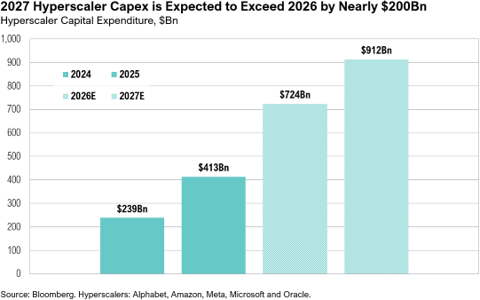
- The AI capex cycle remains extraordinary. Hyperscaler spending has risen from roughly $156 billion in 2023 to an estimated $443 billion in 2025, with consensus nearing $920 billion by 2027.
- The debate has shifted from demand to durability. AI demand looks real; the harder question is whether spending normalizes toward a higher steady state or cracks under capex scale, depreciation, circular financing, buyer concentration and debt-funded growth.
- The capex beneficiaries look more cyclical than the bulls assume. Hardware, memory, commodity compute, neocloud capacity and parts of the power-equipment chain may correct if supply catches demand.
- Meta matters because it cuts both ways. Selling excess compute can turn capex into an earning asset, but it also challenges the compute-scarcity story behind AI hardware valuations.
- Power and nuclear still have legs, but not in a straight line. Data-center load, grid constraints and generation needs are real, while nuclear sentiment looks quiet despite improving fundamentals.
- Software is vulnerable, not uninvestable. AI threatens seat-based horizontal SaaS, but essential workflow software may prove more durable than feared.
- Leadership may broaden. Momentum looks vulnerable, and we see room for the bull market to widen beyond AI-capex recipients as AI adoption begins supporting margins across the broader market.
Setting the Stage
In the sections below, we outline our current thinking on the artificial intelligence (AI) investment cycle. To explore the key arguments shaping the debate, we have structured it as a Q&A between a hypothetical AI “bull” and AI “bear” across several key questions. The views presented are illustrative arguments from each side of the debate. Our conclusions and portfolio implications are discussed in the Summary View section.
The launch of ChatGPT in November 2022 sparked the largest corporate capex cycle on record. The five largest U.S. hyperscalers—Microsoft, Alphabet, Amazon, Meta, and Oracle—spent roughly $156 billion on capex in 2023, rising to $240 billion in 2024 and around $400 billion in 2025. Guidance points to over $700 billion in 2026, with consensus approaching $900 billion in 2027 and cumulative AI-related spend expected to reach several trillion dollars over the next five years.
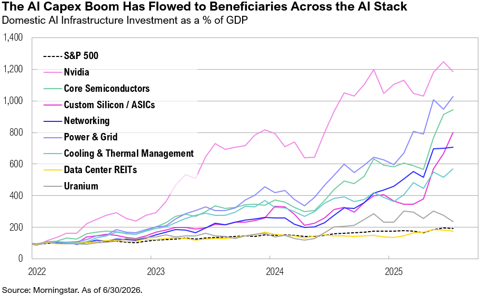
The trade that followed unfolded in distinct layers. Nvidia was the first beneficiary as the picks-and-shovels supplier of GPUs at the center of every AI cluster, with its market cap rising from roughly $400 billion at ChatGPT’s launch to more than $4 trillion at recent peaks. The supply chain followed: TSMC as the leading-edge foundry, ASML as the sole supplier of advanced lithography, and memory providers SK Hynix, Samsung Electronics, and Micron Technology as bandwidth became a binding constraint. Custom silicon providers such as Broadcom and Marvell benefited from hyperscaler ASIC programs, while networking emerged as the next bottleneck. The constraint then moved beyond compute. By mid-2024, power became the binding limit, benefiting utilities, independent power producers, and nuclear operators. The trade then extended into grid infrastructure (Eaton, GE Vernova, Quanta Services), followed by cooling, data center real estate in power-constrained regions such as Northern Virginia, Phoenix, and Texas, and ultimately into the nuclear fuel cycle, where uranium miners and enrichment providers saw their first sustained bull market since the 1970s.
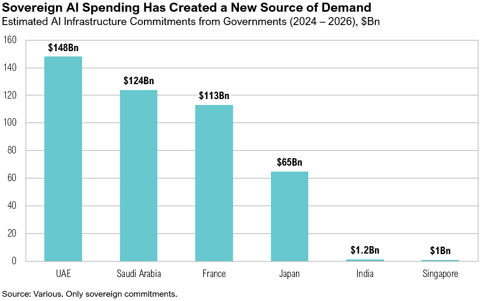
The effects were not confined to U.S. markets. Korean memory, Taiwanese foundry and packaging, Japanese semiconductor equipment, Dutch lithography, and Indian engineering services all benefited as the AI supply chain monetized globally. Sovereign AI initiatives from the UAE, Saudi Arabia, Singapore, and several European governments added a new source of demand that barely existed before late 2024.
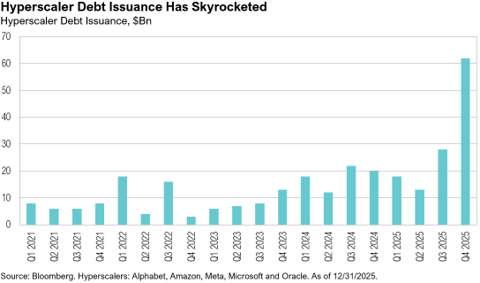
The impact extended well beyond equities. Hyperscalers became major issuers in investment-grade credit markets, while private credit absorbed a significant share of data-center financing. Corporate demand for capital increasingly competed with sovereign issuance, while power, uranium, copper, and other infrastructure-linked commodities benefited from the physical AI buildout. Within equities, concentration increased meaningfully. The Magnificent Seven’s share of the S&P 500 reached roughly 35% at its peak in 2025, with technology and semiconductors returning to dot-com-era weightings. Software experienced a sharp dislocation as investors reassessed the durability of traditional business models in an AI-driven environment. The S&P 500 has risen substantially since ChatGPT’s launch, but much of the performance can be traced directly or indirectly to the AI capex cycle—through both the spenders and the beneficiaries.
As the cycle has matured, the debate has shifted: the question is no longer whether AI demand is real. It is. The question is whether the financial and economic structure built around it—capex, depreciation, financing, valuations, concentration, and macro impact—is durable or not.
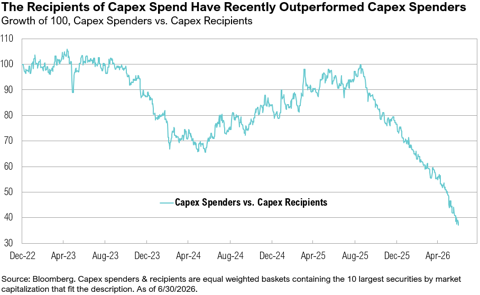
That question has become more relevant as leadership has broadened and beneficiaries of AI spending have substantially outperformed the spenders. Questions around productivity, sustainability, returns, and remaining bottlenecks have moved to the forefront. The answer remains unsettled, with reasonable investors drawing very different conclusions from the same data.
Debate at a Glance
The table below summarizes the dozen questions shaping the AI capex debate. We move from whether the technology is creating measurable value, to whether the spending and demand behind it are durable, where the beneficiaries sit, how clean the earnings are, and what signals would suggest the cycle is changing. For readers who want the full argument, the detailed bull/bear debate is included in the appendix.
| Question | Bull Case | Bear Case |
|---|---|---|
| 1. Is AI creating measurable economic value? | AI is delivering measurable productivity gains, especially in coding, automation and drug discovery. Adoption has been slow, but this is normal for a major technology diffusion cycle. | Economic returns remain uncertain. Many AI agents still require costly supervision, and commercial value has yet to be proven at scale. |
| 2. Is AI capex sustainable? | AI capex is demand-driven, supported by record cloud backlogs and funded by profitable incumbents with strong balance sheets. | AI capex is far above current AI revenue, hyperscaler free cash flow is under pressure, and some demand may depend on subsidized pricing. |
| 3. Do AI labs need to be profitable? | Labs are creating unprecedented demand, with OpenAI exceeding a $20bn annual revenue run-rate and Anthropic gaining enterprise traction. | Valuations still depend on rapid revenue growth, falling inference costs and continued access to strategic and private capital. |
| 4. Who is ultimately funding AI demand? | Enterprise, sovereign and investment-grade demand is broadening beyond the frontier labs. | Some demand still traces back to venture-backed labs and neoclouds, increasing counterparty risk. |
| 5. Are AI infrastructure suppliers cleaner beneficiaries, or just more cyclical? | Suppliers monetize AI capex directly while avoiding much of the hyperscalers’ depreciation, utilization and end-customer monetization risk. | Suppliers remain exposed to the same capex cycle, with rapid hardware obsolescence, softening GPU rental prices and pricing pressure. |
| 6. Are AI infrastructure moats sustainable? | CUDA, scale, supply-chain access and software ecosystems remain meaningful barriers to entry. | Token costs are falling, models are converging, customers are building custom silicon and inference is becoming more hardware-agnostic. |
| 7. Do reported earnings reflect economic reality? | Financial reporting is disclosed, audited and broadly consistent with existing standards; older GPUs may retain value in inference workloads. | GPUs may have economic lives of 1–2 years versus 5–6 years of accounting depreciation, and circular financing raises revenue-quality questions. |
| 8. How important is geopolitics? | Export controls reinforce U.S.-aligned supply chains and accelerate sovereign AI investment outside China. | DeepSeek demonstrated that frontier AI can be trained more cheaply, challenging compute-demand assumptions and the durability of export controls. |
| 9. Is power the binding constraint? | Power remains one of the most investable physical bottlenecks, supporting utilities, grid infrastructure, generation and equipment demand. | The theme has legs, but announced demand may be double-counted, timelines are long and power-linked winners will likely be volatile. |
| 10. Is software an opportunity or a casualty of AI? | AI agents may erode seat-based pricing, reduce seats and pressure margins in horizontal SaaS. | Essential workflow software may prove more durable than feared because data, compliance, integration and permissioning are hard to replicate. |
| 11. How important is AI to U.S. growth? | AI capex remains additive, and slower spending could help hyperscalers if it improves free cash flow and buyback capacity. | If capex stops accelerating, the GDP impulse, earnings contribution and wealth effect could fade while depreciation catches up. |
| 12. What would signal the cycle is ending? | Capex guidance, backlog conversion, sovereign demand and tight credit spreads suggest the cycle remains intact. | Watch GPU rental prices, backlog conversion, buildable power capacity and credit appetite as funding shifts toward debt, leases and private credit. |
Summary View
AI demand appears more durable than the bear case suggests. Models continue to improve, users are becoming more sophisticated, and workflows are gradually being rebuilt around AI’s strengths and weaknesses. At the same time, costs need to fall for enterprise adoption to continue, and the market may be underestimating how difficult it is to ship AI tools into essential workflows. Reliability, permissioning, compliance, integration and change management matter. That is why many software businesses should survive, and some may thrive, as AI improves product velocity, service efficiency and margins.
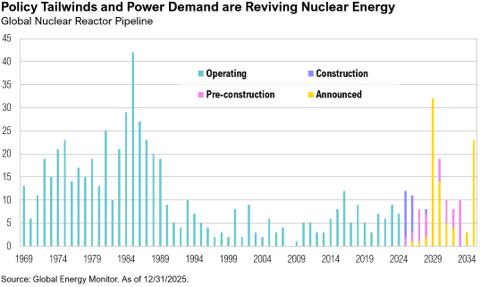
We also continue to believe the power side of the buildout has legs, though the path will be volatile. Data center load, grid constraints, generation needs and equipment bottlenecks are real, but announced demand will be revised, projects will be delayed and some AI linked power winners will correct along the way. Nuclear stocks are one area where sentiment has gone quiet despite improving fundamentals, as projects continue moving forward and contract economics are firming.
The most commoditized parts of the buildout are likely to be more cyclical than the bulls assume. Hardware, memory, commodity compute and parts of the power equipment chain can still be good businesses, but less attractive investments if demand slows or supply catches up. High beta momentum names across technology and industrials are especially vulnerable to mean reversion after outsized returns over the past year.
Meta’s move to sell excess AI compute brings this tension into sharper focus. The optimistic read is that Meta is turning some capex into an earning asset. The skeptical read is that it challenges the scarcity story behind AI hardware valuations. If one of the largest buyers of AI infrastructure is also becoming a seller, and lease prices begin to fall, that story becomes harder to sustain. Meta becoming a seller of compute does not mean the AI cycle is ending, but it does suggest the debate is shifting from “can they build enough?” to “what happens when supply catches up?”
From here, the most important portfolio question may be whether leadership broadens. The exceptional performance of AI capex momentum has started to invite mean reversion, while Healthcare, Financials, Energy and Real Estate have begun to outperform after years of relative weakness. If hyperscaler spending slows because capacity is catching up rather than demand collapsing, the spenders themselves could begin to perform better through improved free cash flow, lower financing needs and renewed buyback capacity, which is why we have begun adding to this side of the trade with a small U.S. large-cap growth index position funded by trimming a tactical cybersecurity holding that rallied sharply since May, and we intend to build on it over time.
We will be watching the market’s reaction to any sign of spending discipline or fresh capex announcements from the hyperscalers for a tell: if discipline is rewarded rather than punished, the next phase of the AI trade may be less about capex recipients alone and more about where AI adoption starts to support margins across the rest of the market.
Appendix: The Full Bear/Bull Debate
The questions below follow the flow of the AI investment cycle—from the usefulness of the technology, to where the spending originates, who is ultimately paying, where it lands, how it is reflected in corporate earnings, and what conditions are required for the cycle to continue.
Question 1: Does AI actually work, and if so, where is it showing up—in corporate margins, productivity, or still mostly in the theoretical capabilities of the models themselves?
AI Bull: The right framing is to separate capability from deployment stage. AI works, and the evidence is not theoretical. On coding productivity, the most measurable and economically significant early application, peer-reviewed studies document 20 to 55 percent reductions in task-completion time. Tools like GitHub Copilot are now embedded across enterprise software-development workflows. In drug discovery, AI-assisted protein-design and discovery workflows have moved from research settings into clinical pipelines. Customer-service automation at companies including Shopify and Duolingo has shown that AI can support production workflows, not just demos. What is not yet visible is the macro aggregate, which is not surprising.
General-purpose technologies historically take years, often decades, to diffuse from frontier use cases into aggregate statistics. Electricity took roughly forty years. The PC took roughly fifteen. That lag exists not because the technology fails, but because full deployment requires complementary investments in workflows, training, and organizational redesign. We are four years into a technology cycle advancing faster than any prior computing platform. Expecting it to appear cleanly in BLS productivity statistics today is the wrong benchmark. The productivity is visible in early adopters. The question is how fast it generalizes.
AI Bear: The distinction that matters is capability versus consequence. The models are impressive. The question is whether impressive technology translates into economic transformation on a timeline that justifies the capital being deployed. History is full of technologies that worked but did not matter at the scale their proponents expected—supersonic passenger flight, nuclear power, virtual reality, 3D printing, blockchain. Each was real. Each was demonstrably capable. None reshaped GDP the way early advocates predicted.
AI faces a specific version of this problem: the capabilities that impress in demos—reasoning, creativity, autonomy—are precisely the capabilities that can fail unpredictably in production. The economic value of a technology that works 95% of the time is not 95% of the value of a technology that works 100% of the time. In many enterprise contexts it is zero, because the cost of supervising and correcting the 5% of failures can exceed the savings from the 95% that worked. That is not just a temporary limitation pending a software patch. It is an architectural property of probabilistic systems operating in deterministic enterprise environments.
The coding productivity studies also measure narrow task-completion time, not end-to-end engineering output. A developer who completes individual tasks 30% faster but spends equivalent time reviewing and correcting AI-generated code has not made the organization 30% more productive. The broader scaling assumptions have also been revised by the labs themselves. The pace of frontier-model capability improvement per dollar of compute has slowed materially over the past eighteen months, and lab messaging has shifted from “scale is all you need” to “scale plus new techniques.” If the next generation of gains requires architectures that have not yet been invented, then an investment case built on linear extrapolation of 2022 to 2024 capability gains is resting on a premise the labs have themselves abandoned.
AI Bull: The enterprise pilot failure data requires careful reading. MIT’s NANDA study captures the first wave of bolt-on deployments—AI tools grafted onto existing workflows without organizational redesign. MIT’s GenAI Divide work suggests materially better outcomes when AI is integrated into redesigned workflows rather than layered onto legacy processes. The 95% failure rate is a measurement of the first deployment strategy, not a ceiling on what the technology can do.
The more consequential development is the shift from chatbots to agents. The first generation of AI products were episodic—useful for discrete tasks, but structurally incapable of owning a workflow end to end. The current generation is agentic: systems with memory, tool access, and the ability to execute multi-step workflows inside enterprise systems. Anthropic, OpenAI, Google, and Microsoft have all shipped production agent products in the past eighteen months. Critically, agents address the structural limitation the bear identifies: the capability missing from first-wave deployments—sustained task execution, deep workflow integration, and measurable end-to-end output—is precisely what agentic architecture is designed to deliver. Shopify has publicly disclosed material productivity gains from internal agent deployment. Salesforce has attributed professional-services cost reduction to agent-driven automation. These are not demos. If 2025 and 2026 were years of the pilot, 2027 is the year of the deployed workflow.
AI Bear: The distinction between bolt-on and workflow-integrated deployments is real, but it does not rescue the productivity thesis on the timeline being implied. Workflow redesign takes years. Telling investors that AI will matter once enterprises finish restructuring around it is not a 2026 or 2027 productivity story—it is a second-half-of-the-decade story, and it provides little support for capex running at hundreds of billions of dollars annually today.
The agent narrative deserves the same scrutiny the chatbot narrative warranted. Reliability problems do not disappear in an agent architecture; they compound, because every step in a multi-step workflow introduces another failure mode, and the failure modes of autonomous agents are more expensive and harder to detect than those of chatbots. Microsoft’s internal review reportedly concluded that deploying complex AI agents at enterprise scale can cost more than paying humans to perform the same tasks once tokens, infrastructure, and supervision overhead are included. Klarna’s decision to rebuild parts of its human customer-service operation after AI-driven quality deterioration is more informative than any aggregate pilot statistic. The Shopify and Salesforce examples are directionally interesting, but they are not yet evidence of sustained, large-scale productivity improvement sufficient to justify the infrastructure being built around it.
That is the problem with the AI story: the goalposts keep moving. First from capability to adoption metrics, then from adoption to agents. Each transition is presented as evidence of progress, but progress in the capability story is not the same as progress in the economic story. The question posed was where AI is showing up in corporate margins and productivity, and the answer is still not strong enough to justify the capital being deployed. That gap is the central risk.
Question 2: Is AI capex sustainable at current levels, or are we watching the largest misallocation of corporate capital in modern history?
AI Bull: Hyperscalers have repeatedly stated that they are responding to demand rather than speculating on it. Google Cloud’s backlog exceeds $460 billion, AWS’s backlog exceeds $360 billion, and Oracle’s remaining performance obligations sit near $523 billion. These are contracted future revenues, not aspirational forecasts. Capacity remains constrained, and the companies funding the buildout have some of the strongest balance sheets in the world. Unlike much of the Tech Bubble, this cycle is being funded by highly profitable incumbents rather than unprofitable startups.
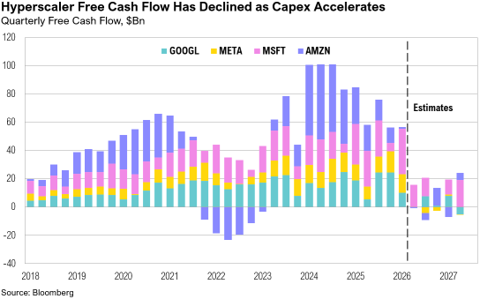
AI Bear: The scale of spending is unprecedented. AI-related capex relative to EBITDA has surpassed levels seen during both the 2014 energy investment boom and the late-1990s telecom buildout. Capex has reached 39% of revenue at Microsoft and 44% at Meta, while direct AI revenues are estimated at only $70–80 billion annually. Hyperscaler free cash flow is going negative this year for the first time.
The problem is not that demand is fake. The problem is that some of it may be uneconomic at the price being charged. Much of the demand is concentrated among unprofitable AI companies that remain dependent on external financing and are effectively selling the product below cost. The Starbucks analogy gets to the point: if Starbucks sold coffee for 25 cents, there would be a shortage of Starbucks coffee. A compute shortage at subsidized prices proves little; the real test comes when compute is priced at its full cost. Early evidence is not encouraging: GPU rental rates barely cover the cost of the GPUs themselves, and leveraged compute providers such as CoreWeave and Nebius continue to run large losses despite operating in a supposedly supply-constrained market.
AI Bull: The free cash flow argument misreads the capital allocation decision. The hyperscalers are not distress-spending; they are choosing to invest over buybacks because they believe the marginal return on AI infrastructure exceeds the cost of capital. Amazon redirected over $100 billion of planned buybacks into capex. Microsoft, Alphabet, and Meta made similar pivots. That is not financial stress. It is a prioritization decision by management teams with long records of compounding capital.
AI revenue is also understated in direct comparisons to capex. Inference runs on the same cloud infrastructure that already generates cloud revenue. The backlog figures are the best available proxy for forward demand, and they are contractually committed by named, credit-rated counterparties. Meta’s decision to monetize infrastructure directly adds another support: a new revenue stream that converts capex into an earning asset and validates the “invest over buybacks” logic.
AI Bear: Prioritizing reinvestment over buybacks is rational only if returns materialize on schedule. If adoption is slower than projected, infrastructure sized for demand that arrives years late still depreciates on schedule. The foregone buybacks do not come back.
This is where the Prisoner’s Dilemma matters. Each hyperscaler is compelled to spend to defend its competitive position—a company that pauses risks ceding the next platform to its rivals—so all of them spend, whether or not the aggregate investment earns its cost of capital. Every participant can act rationally, and much of the capital can still prove unproductive and deeply cyclical.
There is also a buyer concentration problem that contracted backlogs obscure. A meaningful share of committed demand comes from entities such as OpenAI, Anthropic, xAI, and CoreWeave, which are themselves dependent on continued external financing. The contracts look solid on the hyperscaler balance sheet. The counterparties behind them are less solid than they appear.
Finally, the overbuild signal is becoming harder to ignore. Meta spending up to $145 billion this year while exploring ways to lease out excess AI capacity is prima facie evidence of overbuild, and it follows SpaceX/xAI doing the same weeks earlier with Colossus, leasing capacity to Anthropic, Google, and Reflection AI. Two hyperscale-class builders turning to compute rental within two months is a supply-catching-demand signal, not a demand signal.
Question 3: Can the frontier AI labs reach profitability before their funding runs out—and does the answer matter for the rest of the thesis?
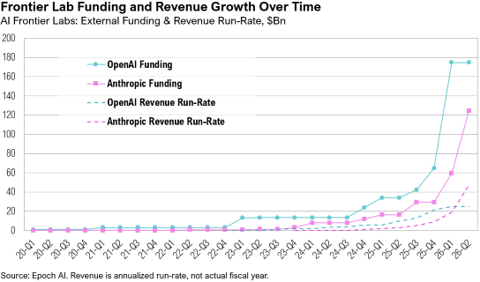
AI Bull: The model labs are among the fastest-growing enterprises in history. OpenAI is on a revenue run-rate exceeding $20 billion, growing at triple-digit rates across consumer subscriptions, enterprise API usage, and custom deployments. Anthropic has signed multi-year enterprise contracts with major financial institutions, healthcare systems, and technology companies. Every major lab has raised at higher valuations and longer commitment horizons through the first half of 2026. The funding market is still answering the question with capital.
AI Bear: The headline revenue figures do not settle the economics. OpenAI needs to roughly quintuple revenue by 2028 to justify its current valuation at any conventional multiple, and that assumes margin expansion in a business where inference costs remain high, competition is compressing pricing, and governance complexity remains a growing overhang. Anthropic may be the more attractive long-term enterprise asset—its Claude models appear to be gaining share in business workflows, and enterprise contract values can be orders of magnitude larger than consumer subscriptions—but the math is still demanding. Even the cleaner asset needs rapid enterprise adoption, falling inference costs, and continued access to capital.
AI Bull: More importantly, lab profitability is not a prerequisite for the infrastructure thesis. The labs do not need to be profitable for the hyperscalers to generate returns. They need to keep buying compute. Microsoft, Google, and Amazon have structured their investments so that lab revenue flows back through their cloud platforms. The labs are demand generators, not independent bets. Even if one lab fails or restructures, the infrastructure does not disappear; demand can migrate to the next model provider, enterprise customer, or sovereign buyer.
AI Bear: The dependency runs deeper than revenue. The labs have signed multi-year compute commitments that assume continued access to venture and strategic capital. If a major lab hits a funding wall, is acquired, restructures, or winds down, the contracted compute demand behind it does not automatically survive. This is not hypothetical: Inflection AI, Stability AI, and several second-tier labs have already dissolved or been absorbed, with their compute contracts following them.
AI Bull: A lab failure still does not crater the thesis. The demand for frontier compute is broader than any single company, and the U.S. government’s Stargate commitment—$500 billion over four years, announced in January 2026—creates a potential non-commercial demand floor that is structurally independent of private lab financing.
AI Bear: Stargate is a policy commitment, not a signed purchase order. Administrations change. The migration thesis also underestimates how entity-specific contracted compute can be. A hyperscaler signs a contract with OpenAI, not with whoever provides frontier models next year. When a lab restructures, the contract restructures with it. Lab profitability may not need to arrive immediately, but the labs do need continued access to capital. If that capital tightens, the infrastructure thesis becomes less independent than the bull case assumes.
Question 4: Who is ultimately paying for all of this—and how stable are those buyers?
AI Bull: The end-buyer base is broader than the headlines suggest. Microsoft’s Azure AI revenue runs through OpenAI, but also through Fortune 500 enterprise deployments with multi-year commercial contracts. AWS Bedrock and Google Vertex have customer rosters that increasingly resemble mature enterprise software markets: financial services, healthcare, retail, manufacturing, and the public sector. Oracle’s $523 billion in remaining performance obligations is anchored by named, credit-rated counterparties disclosed in earnings materials. The model labs are important demand aggregators, but they are not the only buyers.
AI Bear: The problem is that headline backlogs can obscure who is actually underwriting the demand. A meaningful share of contracted AI infrastructure demand still traces back to externally financed counterparties: OpenAI, Anthropic, xAI, CoreWeave, and other neoclouds. xAI’s commercial revenue remains a fraction of its compute commitments. CoreWeave is a leveraged GPU lessor with customer concentration that would not pass a traditional credit committee. The risk is not that AI demand is fake. The risk is that some of today’s demand is capital-markets-dependent, and if funding becomes selective, the contracts, utilization assumptions, and margins behind the buildout may need to be repriced.
Question 5: We can debate the spenders, but what about the beneficiaries? Are chip, networking, memory, and power-equipment companies the cleaner way to invest in AI infrastructure, or are they just the more cyclical expression of the same capex boom?
AI Bull: The suppliers sit in the cleanest position in the AI stack. Companies such as Nvidia, Broadcom, TSMC, ASML, and key networking and power-equipment vendors convert hyperscaler spending directly into revenue while avoiding much of the depreciation, utilization, and end-customer monetization risk. In the first quarter of 2026, Nvidia’s data center revenue run-rate reached roughly $75 billion, up 85% year-over-year. The picks-and-shovels argument remains the cleanest expression of the AI investment thesis: owning the supplier of a critical bottleneck has often been the most attractive way to participate in an infrastructure buildout.
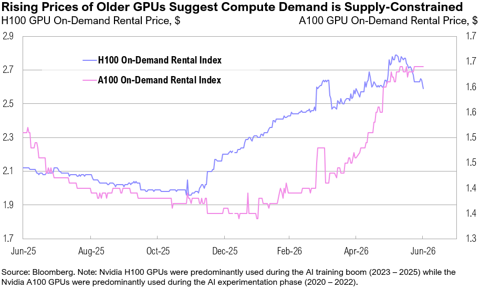
AI Bear: The picks-and-shovels argument only works if the buildout continues. The suppliers may avoid the hyperscalers’ depreciation and utilization risk, but they remain exposed to the same capex cycle. Nvidia has acknowledged that frontier GPUs can become economically obsolete within one to two years in training workloads, even as many customers depreciate them over much longer periods. Secondary-market GPU rental prices have already begun to soften, suggesting supply may be catching up with demand. If spending growth slows, today’s beneficiaries may face the same cyclical pressures that have characterized every previous semiconductor cycle.
Even Micron, one of the most cycle-exposed beneficiaries, has accepted modest discounts to secure five-year customer commitments from hyperscalers. That is rational risk management, but it also suggests management sees more risk in future price declines than in leaving upside on the table. The supplier closest to the cycle is acting as though conditions are closer to the top than the bottom.
Question 6: Is the AI infrastructure business an oligopoly with durable pricing power, or a commodity emerging in real time?
AI Bull: The barriers to entry in frontier AI infrastructure remain enormous. Capital requirements, talent concentration, software ecosystems, supply-chain access, and customer relationships all create meaningful advantages for the incumbents. Nvidia’s CUDA ecosystem remains deeply embedded across the industry, while hyperscalers and leading semiconductor suppliers benefit from scale advantages that are difficult to replicate. Prices are falling, but falling prices do not automatically mean commoditization. In many technology markets, unit prices decline while the leading platforms continue to compound revenue because volume growth, performance gains, and ecosystem lock-in more than offset price compression.
AI Bear: The direction of travel is still hard to ignore. Prices are falling across models, cloud services, and hardware. Frontier models from OpenAI, Anthropic, Google, Meta, and several Chinese labs are increasingly similar in capability, while token costs continue to decline at roughly 10x every eighteen months. Oracle is undercutting the cloud incumbents on price by as much as 40%. Nvidia’s largest customers are designing their own silicon, most notably Google’s TPU and Amazon’s Trainium. A market with falling prices, converging products, and customers building substitutes is not behaving like a durable oligopoly.
AI Bull: Custom silicon economics work only at scale. Google and Amazon have spent years and billions on their own chips, and neither has displaced Nvidia for the most demanding training workloads. CUDA is not just a hardware moat; it is a software ecosystem built over a decade through libraries, optimization frameworks, developer tooling, and installed workflows. Replicating that is not a chip-design problem alone. It is an ecosystem problem. Nvidia is also not standing still: Blackwell and its successors are already in production.
AI Bear: The CUDA moat is real, but narrower than it was three years ago. Open-source software abstractions such as PyTorch, JAX, and emerging model-specific frameworks increasingly reduce hardware dependence. Inference workloads, which are growing faster than training, are more hardware-agnostic and more price-sensitive. The risk is not that Nvidia loses its moat overnight. The risk is that the highest-margin parts of the AI infrastructure stack become less scarce over time, just as customers gain more tools to optimize around them.
Question 7: Are reported earnings accurately reflecting the economics of AI capex, particularly around GPU depreciation and circular financing?
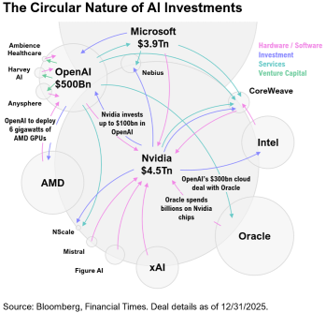
AI Bull: It is worth being precise about the criticism. The issue is not whether these practices are hidden or outside normal accounting standards. They are disclosed, audited, and broadly consistent with existing rules. Useful-life extensions can be justified if GPUs are lasting longer, software is improving utilization, and older chips can be redeployed from training to inference workloads. Strategic investments in customers—Microsoft in OpenAI, Nvidia in CoreWeave, Amazon in Anthropic—can also be interpreted as investments in the future drivers of compute demand, not simply as vendor financing. The structure is complicated, but complexity alone does not make the earnings low quality.
AI Bear: The issue is not disclosure. The issue is whether the accounting fully captures the economics. On depreciation, Nvidia has indicated that frontier GPUs can become economically obsolete within one to two years in competitive training environments, yet many hyperscalers depreciate them over five to six years. If the true useful life is shorter, current earnings may overstate underlying profitability. On capital allocation, capex is increasingly replacing the buybacks that once defined the hyperscaler investment case. On circularity, companies such as Nvidia have invested in or financed customers that subsequently purchase their products, echoing the vendor-financing patterns that appeared late in the telecom buildout.
AI Bull: That is a fair concern, but it should not be overstated. Redeployment matters. A GPU that is no longer frontier for training may still be highly useful for inference, enterprise workloads, internal tools, or lower-intensity model serving. Accounting useful life does not need to match the period of peak training performance. And the strategic-investment point cuts both ways. If Microsoft, Amazon, Google, and Nvidia are using their balance sheets to secure demand, align customers, and build the next compute platform, that can be rational ecosystem formation rather than circularity for circularity’s sake.
AI Bear: CoreWeave is the cleanest example of why investors should still be careful. Nvidia is an equity investor in CoreWeave. CoreWeave purchases GPUs from Nvidia using debt and equipment financing. Microsoft is CoreWeave’s largest customer, providing the revenue stream that services the debt. Microsoft is also an Nvidia customer directly, and an investor in OpenAI, which is itself a CoreWeave customer. None of this is hidden. All of it is disclosed. The question is whether revenue circulating through a small network of strategic counterparties deserves the same multiple as revenue from an independent customer paying out of operating cash flow.
Question 8: How do U.S.-China technology competition and export controls reshape the AI investment thesis?
AI Bull: Export controls have made the U.S. AI supply chain more defensible. ASML’s EUV monopoly, TSMC’s leading-edge manufacturing, and Nvidia’s CUDA ecosystem are protected by a combination of technology, scale, and government policy. Restrictions on Huawei, SMIC, and advanced chip exports make it harder for Chinese competitors to replicate the full frontier stack within an investor-relevant time horizon.
Export controls have also accelerated sovereign AI demand outside China. The UAE, Saudi Arabia, Singapore, India, Japan, and Europe have all committed to national AI infrastructure programs that rely heavily on U.S.-aligned architecture. In that sense, geopolitics is not only restricting Chinese demand; it is also creating new demand from countries that want domestic AI capability but cannot build the full stack themselves.
AI Bear: DeepSeek demonstrated that the moat is not absolute. Its January 2025 release showed that highly capable models could be trained more cheaply, and on restricted hardware, than many investors had assumed. That challenged two pillars of the bull case at once: China may be less isolated than expected, and compute efficiency may improve faster than capex models assume. If less compute is required for frontier or near-frontier capability, the demand assumptions behind the buildout become less secure.
Export controls also create retaliation risk. China’s dominance in rare earths, battery materials, and certain manufacturing inputs is a structural vulnerability that geopolitical competition makes more acute, not less. The same policy environment that protects Nvidia’s moat also exposes the broader supply chain to Chinese countermeasures.
AI Bull: The DeepSeek narrative has been overstated. DeepSeek still relied on Nvidia hardware, and efficiency gains do not scale linearly to frontier capability. The most capable models still require large amounts of advanced compute, high-bandwidth memory, networking, power, and engineering talent. Export controls may not prevent China from building capable models, but they can still raise the cost, slow the pace, and reinforce the value of U.S.-aligned supply chains.
AI Bear: That is exactly why this deserves a risk premium. A moat based partly on policy is less durable than a moat based purely on technology or customer lock-in. Administrations change. Trade negotiations create exceptions. Enforcement lags capability. The thesis that says “China cannot build frontier AI because U.S. policy prevents it” is more fragile than “U.S. companies have superior technology.”
Question 9: Power has emerged as a binding constraint on the AI buildout. Is that bullish because it justifies further capex, or bearish because it caps the buildout?
AI Bull: Power scarcity is real, and remains one of the most investable physical constraints of the AI cycle. The bottleneck no longer stops at GPUs, networking, or memory; it now extends into generation, transmission, grid equipment, cooling, and data-center siting. That justifies multi-year contracts for baseload power, accelerates investment in gas turbines and grid infrastructure, and creates rate-base growth for regulated utilities serving data-center load.
AI Bear: Power scarcity is real, but the market may be drawing the wrong conclusion. Utilities and grid operators are increasingly flagging that hyperscaler demand is being double-counted across multiple sites and regions, as developers reserve optionality wherever capacity might be available. The announced gigawatt pipeline may therefore overstate the amount of demand that will actually be interconnected, financed, and built. If that demand is reconciled downward, the names that re-rated on AI-linked power scarcity could derate as quickly as they rose.
AI Bull: The double-counting concern applies mainly to speculative pipeline, not to permitted, financed, and contracted projects. The credible buildable pipeline remains well ahead of available supply. Nuclear power purchase agreements are also harder to dismiss as option value; they require meaningful upfront commitments from both sides and signal that hyperscalers are willing to pay for long-duration, reliable power. For investors, the cleanest opportunity may be less about betting on every announced data center and more about owning the infrastructure needed to serve the projects that actually get built.
AI Bear: Nuclear commitments are real, but the timeline is the problem. New nuclear capacity can take a decade or more to permit, finance, and commission. Near-term data-center demand will have to be met by existing grid capacity, natural gas, transmission upgrades, and behind-the-meter solutions. That is a different investment thesis from the clean, long-duration nuclear story the market wants to tell. Power may remain the binding constraint, but if it delays projects, raises costs, or forces demand to migrate, it can cap the buildout rather than extend it.
Question 10: We have written before about the SaaSpocalypse—the compression of software valuations on fears that AI agents would erode seat-based pricing. Was that selloff a buying opportunity or the early stage of a structural re-rating?
AI Bull: The SaaSpocalypse was not an overreaction. It was the market beginning to discount a genuine threat to the software profit pool. Seat-based pricing has been one of the great advantages of SaaS: companies paid for access across employee bases, not just for measured consumption. AI agents attack that model directly by automating workflows, reducing seats, and shifting value away from application vendors toward the AI layer. If customers can use agents to complete tasks previously performed inside horizontal SaaS tools, then software vendors may capture a smaller share of the value they create. Revenue may not collapse overnight, but the margin structure and valuation multiple can compress.
AI Bear: The selloff was indiscriminate, and the recovery has been selective, which is what one would expect when the market misprices a heterogeneous group. AI may pressure horizontal seat-based applications, but vertical software, infrastructure software, cybersecurity, and physical-to-digital applications have more durable moats because they are tied to workflow depth, data integration, compliance, permissioning, and mission-critical systems. Cursor can disrupt a coding workflow; it has not replaced Salesforce’s CRM, ServiceNow’s workflow engine, or Workday’s HR system.
AI Bull: The incumbents are adopting AI, but so are their customers—and customers are adopting AI to do more with fewer seats, fewer licenses, and less manual workflow. That is a substitution risk, not just an enhancement opportunity. AI-native companies such as Cursor, Harvey, Writer, and Glean are attacking enterprise workflows from new angles, often with leaner cost structures and faster product cycles than legacy SaaS vendors. The pace has been slower than feared, but the direction remains uncomfortable for large parts of horizontal application software.
AI Bear: The incumbents are not defenseless. AI-native applications still need enterprise data, workflow integration, security, compliance, permissioning, and distribution. The best software companies are embedding AI into existing products, using it to deepen customer value and improve their own development velocity. The moat evolves; it does not simply disappear. The right conclusion is not that all software is uninvestable, but that the market needs to distinguish between software whose value is tied to seat volume and software whose value is tied to embedded workflow, data, and control points.
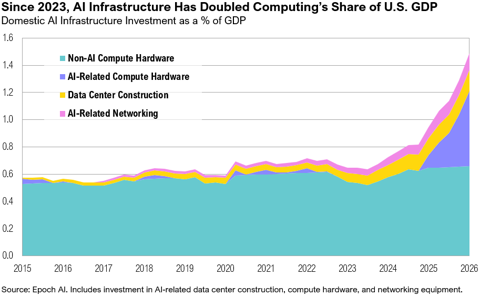
Question 11: A meaningful share of recent U.S. economic growth has been attributed to AI capex. What happens if it slows?
AI Bull: AI capex has been additive to growth, but it is not the only thing holding the economy together. The labor market remains resilient, household balance sheets are broadly healthy, and the productivity benefits from AI adoption are beginning to show up in services, finance, software development, and customer support. Even if capex growth moderates, the installed base continues to support inference, enterprise adoption, cloud revenue, and future productivity gains. Technology equipment and software investment has reached roughly 4.4% of GDP, approaching dot-com-era levels, but this cycle is being funded by highly profitable companies rather than speculative entrants.
AI Bear: The economy has become more dependent on the AI investment cycle than headline GDP suggests. Some estimates suggest AI-related capex accounted for more than half of U.S. GDP growth last year, while AI-linked equity gains helped support spending among higher-income households. The risk is not that capex must collapse to matter. It is that if capex merely stops accelerating, the contribution to GDP growth, earnings growth, and equity-market wealth effects can fade quickly.
AI Bull: A moderation in capex would not necessarily be bad. If hyperscalers slow spending because capacity is catching up to demand, the market may reward better free cash flow, lower financing needs, and a return to buybacks. The spenders have already lagged many of the beneficiaries, so capex discipline could be positive for parts of the market. The macro question is whether spending slows because the opportunity set is maturing, or because demand is disappointing. Those are very different outcomes.
AI Bear: The second-order issue is depreciation. The hyperscalers’ planned capex through 2030 implies roughly $400 billion in annual depreciation expense at standard rates—more than their combined 2025 profits. If revenue growth and utilization do not keep pace, the market may discover that some of today’s apparent earnings power was flattered by capex that had not yet fully flowed through the income statement. That is not a recession call, but rather an earnings-quality and margin-risk problem that the macro data may not reveal until later.
Question 12: What signals would tell us this cycle is ending, and how concerned should we be about the shift in how it is being funded?
AI Bull: The signals that would matter are clear, and most of them are not yet flashing. The first is hyperscaler capex guidance—not for the next quarter, but for 2027 and 2028. As long as forward guidance continues to rise, the demand the operators are seeing is outrunning the capacity they are building. The second is the conversion of contracted backlogs into recognized revenue. Google Cloud, AWS, and Oracle have collectively booked roughly $1.3 trillion in remaining performance obligations; the bear case requires those to either not convert or convert at lower margins. Both are observable in real time. The third is sovereign and enterprise demand outside the hyperscaler complex, which has grown meaningfully and is structurally non-correlated with U.S. tech-sector financial conditions. The UAE, Saudi, Singapore, France, India, and Japan have all committed to multi-year sovereign AI buildouts that depend on U.S. infrastructure and U.S. capital markets, adding a second-order demand source that did not exist eighteen months ago. On financing: yes, the funding mix has shifted. Hyperscalers issued roughly $428 billion of investment-grade debt in 2025, and projections call for another $1.5 trillion over the next several years. But these are the highest-rated corporate credits in the market, issuing at modest spreads, into deep demand. Credit markets have priced this issuance willingly. The shift from buybacks to debt-financed capex is rational capital allocation when the cost of debt remains below the marginal return on AI infrastructure. That math holds today, and there is no sign the credit markets are demanding wider spreads to fund continued issuance.
AI Bear: The signals to watch are simpler than the bull suggests, and several are already showing strain. The first is the conversion rate of pipeline gigawatts to operating data centers—announced capacity has decoupled from interconnected, financed, and water-secured capacity, and that gap is the single most observable measure of how much of the demand is real. The second is the secondary market for GPU compute, where rental prices have begun softening despite continued reported capex growth, an early warning that supply is starting to catch demand. The third is the willingness of investment-grade credit markets to keep absorbing hyperscaler issuance at current spreads. This is where the bull case is most exposed. The capex cycle has now outgrown the operating cash flow of the companies financing it. Free cash flow at the largest hyperscalers is going negative this year for the first time. The shift to debt is not optional; it is structural. Hyperscaler IG issuance reached $428 billion in 2025, with another $1.5 trillion projected to fund the buildout through 2030. Private credit is absorbing the data-center financing the public markets cannot. Equipment finance, lease structures, and SPV vehicles are increasingly carrying capex off the hyperscaler balance sheets. When a cycle transitions from being funded by operating cash flow to being funded by debt and off-balance-sheet structures, the cycle has changed shape. It is no longer a self-funding investment program. It is a leveraged buildout. Every prior leveraged corporate capex cycle—telecom in 1999, energy in 2014, commercial real estate in 2007—ended when credit markets stopped absorbing issuance at attractive spreads. That signal has not arrived. When it does, it will not arrive slowly.
AI Bull: The credit signal the bear describes is a real risk—but timing matters. Investment-grade spreads for Microsoft, Alphabet, Amazon, and Meta remain near historic tights. If the cycle ends, it ends when those spreads widen, not before. We are not there.
AI Bear: Credit spreads are a lagging indicator, not a leading one. They do not widen until liquidity tightens, and liquidity tightens faster than spreads imply. The 2007 CMBS market traded near tights until it did not. The 1999 telecom paper was oversubscribed until it was not. The absence of spread widening today is consistent with both “the cycle continues” and “the cycle is ending but credit hasn’t noticed yet.” Those are different theses that currently look the same.
About WindRock
WindRock Wealth Management is an independent investment management firm founded on the belief that investment success in today’s increasingly uncertain world requires a focus on the macroeconomic “big picture” combined with an entrepreneurial mindset to seize on unique investment opportunities. We serve as the trusted voice to a select group of high-net-worth individuals, family offices, foundations and retirement plans.
www.windrockwealth.com
312-650-9602
assistant@windrockwealth.com
All content and matters discussed are for information purposes only. Opinions expressed are solely those of WindRock Wealth Management LLC and our staff. Material presented is believed to be from reliable sources; however, we make no representations as to its accuracy or completeness. All information and ideas presented do not constitute investment advice and investors should discuss any ideas with their registered investment advisor. Fee-based investment advisory services are offered by WindRock Wealth Management LLC, an SEC-Registered Investment Advisor. The presence of the information contained herein shall in no way be construed or interpreted as a solicitation to sell or offer to sell investment advisory services. WindRock Wealth Management may have a material interest in some or all of the investment topics discussed. Nothing should be interpreted to state or imply that past results are an indication of future performance. There are no warranties, expresses or implied, as to accuracy, completeness or results obtained from any information contained herein. You may not modify this content for any other purposes without express written consent.